
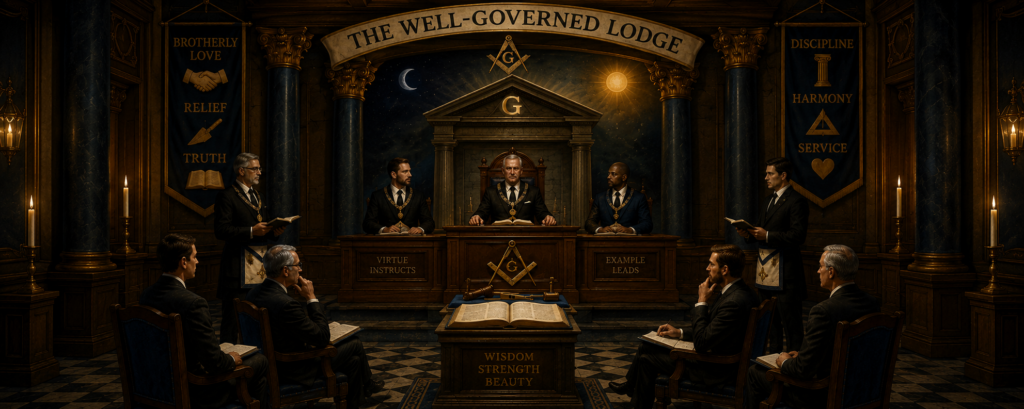
A Leadership Training Manual for Masonic Lodge Officers
Prepared from the Masonic Leadership Training program of the Grand Lodge of Florida
Table of Contents
Introduction
- Leadership in a Volunteer Fraternity
- The Duties of the Lodge Officers
- The Worshipful Master: Authority, Limits, and Duties
- Preparing for Your Year in the East
- Meetings and Committees
- Ritual Excellence
- Finances and the Lodge Budget
- Communication Within and Beyond the Lodge
- Membership: Attracting, Recruiting, and Retaining Brothers
- The Lodge in the Community
- Organizing Successful Events
- Public Speaking for Lodge Officers
Conclusion
Introduction
The operation of a Masonic Lodge is the responsibility of the Worshipful Master and the other elected officers. But no Lodge succeeds on the effort of its elected line alone. A successful Lodge relies on participation from everyone — elected officers, appointed officers, and the Brothers on the sidelines.
This manual exists to prepare Lodge officers for that responsibility. Its purpose is threefold: to ensure our organization has a bright future by maintaining our traditions and rituals, to build on our strengths while understanding honestly where we can improve, and to help officers overcome the generational differences and personality conflicts that arise in any organization of men.
The manual moves from foundation to application. The early chapters establish what leadership means in a fraternal context and what each officer’s station requires. The middle chapters address the machinery of a well-governed Lodge — meetings, committees, ritual, and money. The later chapters turn outward, to membership, community, and the public face of the Lodge.
Read it through once when you take a chair. Return to the relevant chapters as your duties demand. Learn the duties of the position above you, and teach your duties to the position below you — that principle, more than any other, is what keeps a Lodge strong from one year to the next.
Chapter 1: Leadership in a Volunteer Fraternity
You Manage Things; You Lead People
The biggest difference between managers and leaders is the way they motivate people. Rear Admiral Grace Murray Hopper put it plainly: “You manage things; you lead people.”
Managers have subordinates; leaders have followers. Managers deal with tasks; leaders deal with people. This distinction matters everywhere, but it is decisive in a Masonic Lodge, because a Lodge is a volunteer organization. No Brother is paid to attend, to serve, or to work. No officer can compel effort the way an employer can. Everything a Lodge accomplishes, it accomplishes because its members choose to give their time — and men give their time to leaders they respect, not to managers who assign them tasks.
Every principle in this manual rests on that fact. When you plan, communicate, delegate, or correct, remember that the Brother in front of you is a volunteer. Lead him; do not attempt to manage him.
The Keys to Effective Leadership
Effective Masonic leadership rests on five qualities:
- Fairness. Brothers will accept decisions they disagree with if they believe the process was fair. They will not long tolerate favoritism.
- Consistency. A leader whose standards shift from week to week teaches the Craft that his standards mean nothing.
- Sound judgment. Gather the facts, weigh them, and decide. Do not decide first and justify afterward.
- Even temperament. The Lodge takes its emotional tone from its leaders. A Master who stays calm keeps his Lodge calm.
- Willingness to listen — and to understand. Listening is not waiting for your turn to speak. A Brother who feels heard will support the Lodge even when the decision goes against him.
General Rules of Conduct for Leaders
A few rules apply to every officer, in every situation:
Never use threats or intimidation to gain compliance. In a volunteer organization, intimidation does not produce obedience; it produces empty chairs.
Do not make decisions when you are angry. Anger and judgment do not coexist. Defer the decision until your temper has passed.
Treat everyone with respect, and accept criticism gracefully. An officer who cannot take correction cannot credibly give it.
Ask for help when you need it. No officer is expected to know everything or do everything alone, and pretending otherwise serves neither you nor the Lodge.
Finally, remember that election or appointment to office — above all, election to the East — is an honor conferred by your Brethren. Conduct yourself in a way that is worthy of it.
What Every Officer Owes the Lodge
Regardless of station, every Lodge officer shares a common set of obligations:
- Ensure that every Brother who enters the Lodge is warmly greeted and made to feel welcome.
- Obtain all the Masonic education your cable tow will allow.
- Be proficient in the ritual of your station.
- Learn the duties of the position above you.
- Teach your duties to the position below you.
The last two points deserve emphasis. A Lodge in which each officer trains his successor never faces a leadership vacuum. A Lodge in which officers hoard their knowledge rebuilds itself from nothing every year.
The Officer’s Bookshelf
Every Lodge officer should have, and use, the standard references of this jurisdiction:
- The Florida Masonic Monitor (the “Blue Book”)
- The Handbook of Floor Work Procedures
- The Florida Digest of Masonic Law
- The Lodge Officers Handbook
- The Masonic Leadership Training Manual
- The Lodge Secretary Administrative Guide (GL215)
- The Worshipful Master’s Program Notebook (GL218)
- The Mentor’s Manual
An officer who does not know where to find the law cannot be confident he is following it.
Chapter 2: The Duties of the Lodge Officers
This chapter describes the duties of each station below the East, beginning at the door of the Lodge and moving toward it. Two principles frame everything that follows. First, appointed officers serve at the pleasure of the Worshipful Master, and their duties are ultimately governed by his direction. Second, every officer should treat his current chair as preparation for the next one.
The Tyler
The Tyler guards the outer door, but his responsibilities extend beyond it. He takes charge of the paraphernalia, jewels, and other property of the Lodge. He keeps the registration book and ensures that every Brother signs it. When first-time visitors arrive, he sees that they are properly examined and that the Worshipful Master, Senior Warden, and Senior Deacon are made aware of their presence.
The Tyler must also know when not to act. There are times when no alarm should be sounded at the door: during the opening or closing of the Lodge, during the absence of the Senior Deacon in the Entered Apprentice degree, during an obligation, and while the Lodge is balloting. A Tyler who interrupts these moments disrupts the most solemn work of the Lodge.
The Chaplain
The Chaplain leads the Lodge in prayer and serves as Chairman of the Sickness and Visitation Committee. He should commit to memory the prayers and ritual for the opening and closing of the Lodge, the funeral service, and the three degrees. He also assists the Marshal and Stewards in preparing the Lodge rooms and cleaning up afterward.
Two points of guidance. First, remember that Masons never invoke the name of a specific deity in Lodge; use “Heavenly Creator” or “Grand Architect of the Universe.” Second, as chairman of Sickness and Visitation, the Chaplain is responsible for seeing that Brothers in need are tended to — but he is not required to make every visit personally. Ask for help when you need it; organizing the Lodge’s care for its members is itself the duty.
The Marshal
The Marshal assists the Chaplain and Stewards in preparing the Lodge room, assists the Senior Deacon in introducing distinguished visitors, and assists the Stewards in the fellowship hall or dining room. He should memorize the Charges of the three degrees.
The Marshal is generally a wise and experienced Brother with good diction who is at ease speaking before a crowd — which is why the Junior Past Master is often asked to serve in this chair. Like all appointed officers, the Marshal serves at the sole discretion of the Worshipful Master, and his duties are governed by the Master’s wishes.
The Stewards
The Junior and Senior Stewards work as a team. Together they assist the Chaplain and Marshal in preparing the Lodge room, assist the Deacons and other officers in performing their duties, assist the Junior Warden in providing refreshments, and take proper care of the ritual garments. The Junior Steward should also be involved in examining visiting Brothers.
The Senior Steward carries one duty of particular weight: he is in charge of preparing candidates for the degrees, especially the Entered Apprentice. A candidate at the door of preparation is anxious and knows nothing of what awaits him. Be a calming voice; offer words of encouragement. Take great care that his preparation is done with accuracy, dignity, and care. “Duly and truly prepared” is not a formality — it is your responsibility.
The Junior Deacon
The Junior Deacon sees to the security of the Lodge and assists the Senior Warden as he may direct. His term in this chair is also the time to increase his level of Masonic education and become better versed in the Digest. The chairs above him will demand a working knowledge of Masonic law; this is the seat in which to build it.
The Senior Deacon
The Senior Deacon takes charge of the candidates during the degrees, assists the Worshipful Master as he may direct, and presides in the East during an Entered Apprentice degree.
His responsibility for candidates is personal and continuous. He remains responsible for them in all degrees, even when a substitute performs part of the work. Greet each candidate warmly and put him at ease; introduce him to the Worshipful Master and the Brethren. This matters most with Entered Apprentices, for whom the degree is their first experience of Masonry — the impression formed that night will shape their entire view of the Fraternity.
The Senior Deacon’s duty does not end when the degree closes. Accompany the candidates into the fellowship hall afterward and make sure they are relaxed and confident. See that each candidate knows who his catechism coach is, and communicate all expectations clearly to the coach. A candidate who leaves his degree without a coach and a plan is a candidate the Lodge is already beginning to lose.
The Secretary
The Secretary records all proceedings of the Lodge, collects and receives all moneys, reads all correspondence from the Grand Lodge to the Craft, transmits reports to the Grand Secretary, and reports on delinquent dues. He attends all Lodge functions, from Stated and Called Communications to social events.
That list only scratches the surface. The Secretary is the administrative backbone of the Lodge, and a capable Secretary is the Worshipful Master’s most valuable ally. The Lodge Secretary Administrative Guide (GL215) is the essential reference for this office.
The Treasurer
The Treasurer receives and safely keeps the moneys of the Lodge, disburses or transfers them as directed, and keeps an accurate record and account of all receipts and disbursements. He serves on the Budget Committee and presents a statement of the finances of the Lodge as required. His work underpins everything in Chapter 7.
The Junior Warden
The Junior Warden exercises all the powers of the Worshipful Master in the absence of both the Master and the Senior Warden. He attends the Grand Communication — and if he cannot attend, he should appoint a proxy, because the Lodge is entitled to his vote. He takes charge of the Craft during the hours of refreshment, and he presides in the East during a Fellow Craft degree.
The Junior Warden also carries a substantial committee load. He serves as Chairman of the Vigilance Committee and of the Masonic Education Committee, and as a member of the Finance Committee, the Committee on Charity, the Board of Relief, the Committee on Education and Primary Schools, and the Committee on Lodge Property. The South is not a resting place; it is where a future Master learns the full breadth of the Lodge’s work.
The Senior Warden
The Senior Warden exercises all the powers of the Worshipful Master in his absence. He attends the Grand Communication, appointing a proxy if he cannot, because his vote belongs to the Lodge. He presides in the East during a Master Mason degree.
He serves as Chairman of the Finance Committee and as a member of the Committee on Charity, the Board of Relief, the Committee on Masonic Education, and the Committee on Lodge Property. He also holds one distinctive privilege: the right to nominate the Junior Deacon.
The West is the final apprenticeship for the East. Everything in Chapters 3 and 4 should be studied now, not after election.
Chapter 3: The Worshipful Master: Authority, Limits, and Duties
The Character of the Master
Before the law defines what a Master may do, tradition defines what he must be. He should be temperate and meek, yet firm in his decisions. He should be cautious, courteous, and faithful, and practice self-government — no man can govern a Lodge who cannot govern himself. He should respect his Masonic superiors, be a zealous Mason, and be well versed in Masonic law and in the traditions and customs of Masonry and of his own Lodge. Above all, he is charged to maintain the regularity of the Masonic system.
Rights and Privileges
The Worshipful Master’s expressed “will and pleasure” is absolute law in his Lodge, and he must be obeyed in every legitimate official order. But this authority is not unlimited. It is bounded by his installation vows and charges, the Constitution, the resolutions and edicts of the Grand Lodge, the rules and regulations of his own Lodge, and the ancient and established customs of the Fraternity. And it should be exercised in the spirit of leadership rather than command: the Master who must invoke his authority to be followed has already lost his Lodge. He presides with dignity, courtesy, and affability.
Within those bounds, the Master’s prerogatives are broad:
- He guides and controls all the work and business of the Lodge, and may postpone the transaction of any Lodge business when he deems it in the best interest of the Craft.
- He may defer consideration of a petition for the degrees, and he may — and indeed shall — arrest the progress of a candidate if an objection arises.
- He shall abate any irregular proceeding of the Lodge.
- When present in the Lodge, he may act through any Brother whose assistance or skill he desires; those actions become his actions.
- It is his prerogative to appoint all subordinate officers (subject to the Senior Warden’s right to nominate the Junior Deacon) and to appoint all committees, unless the Lodge by-laws specify otherwise.
- He is the judge of the sufficiency of avouchment.
- He may refuse admission to a visiting Brother when it is in the best interest of the Lodge — for example, during sensitive Lodge business, or when any member of the Lodge has a legitimate objection.
- He may command the attendance of Lodge members by summons for important business.
- He may call Communications at any time his judgment deems it necessary.
- He may cast the deciding vote in the event of a tie.
- He supervises all financial matters of his Lodge.
Prohibitions
The office also carries firm limits, and a Master who does not know them will eventually blunder into one. The Worshipful Master:
- Cannot resign without permission of the Grand Master, and cannot demit during his term.
- Cannot be installed prior to December 27.
- Cannot simultaneously hold the office of Grand Master, Deputy Grand Master, or District Deputy Grand Master, and cannot be a petitioner for a Lodge under dispensation.
- Cannot be tried by his Lodge during his term.
- Cannot arbitrarily disband a Lodge or surrender its Charter.
- Cannot order the removal of a disorderly Brother from the Lodge; his remedy is to cease labor until harmony is restored.
- Cannot delegate his authority to preside in his absence — the succession runs to the Wardens by law, not by his appointment.
- Shall not sell, convey, or mortgage Lodge property except by action of the Lodge at a Stated Communication after due notice.
- Cannot transact business at a Called Communication other than the business for which the meeting was called.
- Cannot call a Communication on Sunday except for a funeral, divine service, or very urgent charity.
- Cannot call the Lodge from labor to refreshment to meet on a future date.
- Does not have the authority to suspend a member for non-payment of dues; that requires action of the Lodge.
One principle stands behind all of these: any act or decision of the Worshipful Master may be reviewed by the Grand Lodge — or by the Grand Master when Grand Lodge is in recess. The East is powerful, but it is accountable.
Duties
The Master’s duties fall naturally into several groups.
To the institution. He must act, in spirit and in letter, according to the Ancient Charges to which he gave his assent when installed. He preserves the Charter of the Lodge with unfailing care and delivers it to his successor. He sees that his successor is duly installed, surrendering to him the Charter and the symbols of authority. He attends the Grand Communication, votes the Lodge’s recommendations — not his personal preferences — and reports the proceedings of the Grand Lodge session back to his Lodge.
In the Lodge room. He opens and presides over the Lodge, sets the Craft to work, and gives proper instruction in all matters of Masonic interest. He sees that everyone attending Lodge receives a courteous, friendly, and appropriate welcome. He ensures the minutes are read for correction and approval before the Lodge closes (though he has the power to dispense with the reading). He sees that smoking — including e-cigarettes — is prohibited in the Lodge room. He should postpone matters of extraordinary importance when attendance is very small; major decisions deserve a full Lodge.
Administration and law. He sees that all business and work of the Lodge is properly handled by the responsible officer, and that all Grand Lodge reports are prepared, completed, and transmitted on time — relying on his Secretary, whose competence in this area is indispensable. He ensures that all members understand, respect, and obey the by-laws of the Lodge and the Constitution, regulations, and edicts of the Grand Lodge. He sees that the moral law is respected by all Brothers, that any un-Masonic conduct coming to his knowledge is dealt with accordingly, and that anyone charged with un-Masonic conduct is guaranteed a fair trial and the right of appeal to the Grand Lodge.
Planning and appointments. He prepares the Lodge’s Annual Plan and Annual Budget, and prepares an agenda for each Stated Communication. He ascertains the dates of the District Deputy Grand Master’s official visit and the Grand Master’s official visit to the district. He appoints the Investigating Committee as needed, and appoints all of the Lodge’s standing committees: Finance, Vigilance, Petitions, Masonic Education, Board of Relief, Charity, and Lodge Property.
To the Brethren. He sees that the Craft does not lack instruction in Masonic ritual, principles, and philosophy — Masonic education is a duty of the East, not an optional program. He looks to the well-being of the Lodge and of Masonry within the community. He visits sick or infirm Brothers and the widows of departed Brothers, and ensures that Masonic funeral services are provided for all eligible Brothers. He welcomes each newly raised Brother and invites him to become active. He follows up on every committee assignment that results from his delegation — delegation without follow-up is abdication. And he lends an understanding ear to the Brethren, because much of the real work of the East is simply listening.
Chapter 4: Preparing for Your Year in the East
Plan Early, and Keep Planning
Preparation for the East begins long before installation. Plan your year early and re-evaluate frequently — a plan made in January and never revisited is a wish, not a plan. Ask for advice and help early; the Past Masters of your Lodge have already solved most of the problems you are about to meet. Plan your meetings and then follow your plan. Educate, train, and meet with your officers throughout the year. And in all of it, be worthy of the honor your Brethren have conferred upon you.
Selecting Your Officers
The single most important decision the Worshipful Master makes is the selection of the Brothers who will help him throughout the year. Every other success of your year depends on this one.
When assembling your team, share your vision for the ensuing year and ask directly for assistance. Be excited — a positive mental attitude is contagious, and so is its absence. State your expectations clearly at the outset, and then support and stand by your officers when they act on them.
For appointed officers, remember that each appointment may be the first step of a Brother’s progression through the chairs. Ensure that every appointee understands his duties and responsibilities, and confirm that he is genuinely committed before you place him in the line.
Officer recruitment is a continuous activity, not an annual scramble. Continually evaluate the membership for leadership potential. Share the Lodge’s vision and long-range plan with promising Brothers and include them in development meetings. Convey what is expected during the coming year and what will be expected in future years. Maintain excitement and a positive attitude throughout your term — your zeal will spread through the Craft, and so will your indifference.
Installation
A well-run installation sets the tone for the year, and it requires the same planning as any major event.
Beforehand: select your installation team — Installing Officer, Chaplain, and Marshal — and select Brothers, preferably Past Masters, to fill the chairs during the ceremony. Plan the installation meal. Rehearse. Send notifications through the Trestle Board, social media, and the district associations. Select and purchase the Worshipful Master’s hat.
The ceremony itself follows an established sequence: open the Lodge in the Master Mason degree, close the Funeral Lodge, and proceed with the installation. Afterward, thank the Installing Officers and the Past Masters filling the seats, introduce your wife and family, deliver the Worshipful Master’s message, and introduce the Lodge officers and their families and guests. Presentations and the closing prayer follow; then ask non-Masons to retire, close the Lodge, and reopen the Funeral Lodge.
First Impressions
Before your year begins in earnest, look at your Lodge through a stranger’s eyes. Does the Lodge reflect the beauty our rituals describe? Is every Brother — and every Brother’s family — greeted in a manner that promotes brotherly love? Are you and your Lodge fulfilling the needs and aspirations of every member? These questions have no permanent answers; ask them again throughout the year.
Training Your Officers
Training the line is among the Master’s most consequential duties, because it determines the quality of every Lodge year after yours.
Provide written duties and descriptions to every filled position — do not assume a new officer knows what his chair requires. Hold frequent officers’ meetings. Establish the principle that each officer is responsible for training the Brother behind him, and allow junior officers to perform the duties of the next higher seat so that advancement is a step, not a leap.
Use Grand Lodge materials and training sessions, and communicate training opportunities to the whole Craft. Plan a trip to Grand Lodge so your officers see the Fraternity beyond their own Lodge room.
The goal is a normal line of progression in which officers are trained for the next chair well ahead of installation. Every Brother eligible to vote can hold office, and every officer has the potential to serve his Lodge as Worshipful Master. A Lodge that trains deliberately ensures its Masters arrive in the East with the experience the office demands.
Chapter 5: Meetings and Committees
Officers’ Meetings
The officers’ meeting is the Lodge’s planning session, usually held the week before the Stated Communication. Use it to identify future events — community events, special dinners, Lodge, district, zone, and Grand Lodge events and training, Lodge maintenance, and Masonic youth activities — and to coordinate any item that requires cooperation between officers or committee members. Business that is coordinated in the officers’ meeting moves quickly on the Lodge floor; business that is not consumes the evening.
Lodge Meetings
Stick to your agenda, and conduct routine business concisely. A useful general rule divides the evening in thirds: one-third for Lodge business, one-third for fellowship and refreshment, and one-third for a program — Masonic education, a guest speaker, or similar. Some Lodges alternate, devoting one meeting a month to degree work, awards, or special events and the other to general business. Whatever the pattern, keep it repeatable, and remember that certain functions must occur at every meeting.
A suggested order of business:
- Flag ceremony (before opening the Lodge)
- Reading of the minutes for information and final adoption
- Report of business before the Lodge
- Reports of sickness and distress
- Reports of petitions filed with the Secretary
- Reports from committees on petitions
- Balloting
- Reports of special committees
- Unfinished business
- General business and work
To this may be added communications, new business, announcements, the good of the order, and Masonic education, as the Lodge’s practice dictates.
The Standing Committees
The Worshipful Master has sole discretion to appoint all committee chairmen and members, unless the by-laws provide otherwise. Seven committees are required by the Digest (Chapter 24.05, Section 10.01): Finance, Vigilance, Petitions, Masonic Education, Board of Relief, Charity, and Lodge Property.
Finance Committee. Chaired by the Senior Warden, with up to six members including at least one Past Master. It examines and reports on all matters regarding the financial concerns of the Lodge, and submits its report within thirty days after the close of the Masonic year.
Vigilance Committee. Chaired by the Junior Warden, with two additional members. It watches over the moral conduct of the Craft at all times except during the working hours of the Lodge, corrects irregularities in keeping with the dignity, nature, and principles of the Fraternity, and reports all matters necessary for the vindication of Masonic law and virtue.
Petitions Committee. Composed of not fewer than three nor more than seven members. It reviews all applications for the degrees for correctness and completeness and reports to the Worshipful Master, after which the petition takes its usual course. The committee determines eligibility based on residence, physical and mental qualifications, and personality traits and habits, using the Supplementary Information for Petition (form GL602, Item No. 1602) — any differences between the petition and the supplementary form should prompt questions. Recommended interview topics include belief in a Supreme Being, age, jurisdiction, occupation, whether any reason exists why he should not become a Freemason, whether the petition is made of his own free will, financial ability, what he expects to gain from Masonry, and any prior petitions. The committee should also contact the Brothers who signed the petition and pursue any rumors that could discredit the applicant’s integrity, morals, or record.
Investigating Committee. Appointed by the Worshipful Master whenever the Lodge receives a petition — for the degrees, affiliation, reinstatement, dual membership, or plural membership. It consists of three members of the Lodge who investigate the character and standing of the petitioner. The investigation begins only after the Petitions Committee has interviewed the applicant, the Lodge has received the petition, the Master has appointed the committee, and the Secretary has ordered a background investigation whose results the committee has reviewed. Each member investigates independently; the committee then submits a written report to the Lodge, and may make a unanimous report. It is discharged when the Worshipful Master accepts the report.
This is some of the most important work in all of Masonry. The Investigating Committee is the last line of defense protecting the integrity and sanctity of your Lodge, for the strength of Masonry lies in the quality of its members — “Guard the West Gate,” as Most Worshipful Stan Hudson charged. The committee members are likely the only Masons who will see and hear the petitioner in his own environment, and it is desirable to have his wife and children present for the home interview, since his home life may bear directly on his eligibility and worthiness. The investigation should determine his belief in Deity, his moral and mental standards, his physical and mental qualifications, whether acceptance would create financial or domestic problems, and his motives in petitioning. And it should be conducted in such a manner that even a rejected applicant comes away with higher respect for the Fraternity.
Together, the Petitions and Investigating Committees are the portals of Masonry. They ensure a proper investigation is made, so that neither the Lodge nor the applicant suffers an injustice at the ballot box.
Masonic Education Committee. Chaired by a Past Master, with at least five members chosen for knowledge, dedication, and tact. It reports to the Worshipful Master on each candidate’s progress through the degrees, and reports on the Masonic Education Program described in Regulations 37.12 and 37.18. It maintains a subcommittee called the Lodge Mentor’s Committee.
Regulations 37.12 and 37.18 establish the system of Masonic education: instruction must be given to each candidate before or after the conferral of a degree; the Worshipful Master or a majority of the Lodge must certify to the Secretary that the instruction has been received, and the Secretary must record it; and the candidate must pass an examination before being passed or raised. The Worshipful Master and Secretary are responsible for compliance.
Board of Relief. Composed of the Worshipful Master and the Wardens. It draws upon the Charity Fund as urgent fraternal necessity requires, answers cries of distress, and renders aid as appropriate. It reports to the Lodge quarterly, and may omit a recipient’s name unless the Brother is the object of continued charity.
Committee on Charity. Directed by the Worshipful Master. It keeps community charity on the agenda of every meeting, places articles and pictures of charitable work in the Trestle Board, offers the Lodge’s facilities to organizations that support or perform charitable services, ensures the Lodge contributes to its community on a frequent basis, and advises the Board of Relief on matters of fraternal need.
Committee on Lodge Property. Composed of three to five members. It proposes written rules for the governance and use of Lodge property, negotiates agreements with organizations that use the property, coordinates schedules to avoid conflicts among users, makes recommendations on improvements, repairs, and renovations, and enforces — or reports for enforcement — all Lodge and Grand Lodge rules and regulations.
Additional Committees
Beyond the required seven, your Lodge’s needs may call for others. Common examples:
- Budget Committee — assists the Worshipful Master in developing the budget for the coming year and ensures the Lodge maintains sufficient funds.
- By-Laws Committee — reviews the Lodge by-laws, keeps them current, and ensures Grand Lodge has the latest version on file.
- Delinquent Dues Committee — assists the Secretary and Master with members behind on dues; visits or contacts those Brothers to check on their circumstances and works to retain members who are unable to pay.
- Refreshment Committee — provides refreshments at Lodge functions, supervised by the Junior Warden and Stewards.
- Telephone Committee — calls members within commuting distance two or three days before any Lodge event.
- Trestle Board Committee — collects input from the Master, Wardens, and members; collates it; and ensures the Trestle Board is printed and mailed in time to reach the Brothers. It should also evaluate websites and social media and implement whatever best keeps the Lodge in touch with its members.
- Funeral Committee — maintains a team of competent Masons to perform Masonic funerals and memorial services. A Masonic funeral is a privilege, and it may be the first time a Brother’s family and friends see the respect we hold for him. If your district has a dedicated Funeral Lodge, it is always looking for assistance and is an excellent place to learn the funeral ritual.
- Friendship Night Committee — introduces men identified as potentially good Masons to the Fraternity through Lodge-sponsored Friendship Nights, with appropriate refreshments and a follow-up thank-you letter to attendees and the guest speaker.
- Fundraising Committee — plans fundraisers in compliance with Grand Lodge regulations and state law, drawing help from the district or zone.
- Entertainment Committee — supports special events and maintains a list of members, family, and friends with musical and artistic talents.
- Lodge History Committee — maintains a record of the Lodge’s milestones and prepares presentations to share with the Brethren, families, and the public.
Other possibilities include committees for a billboard or sign, Lodge renewal, long-range planning, public education and publicity, widows, and youth activities. Create the committees your Lodge’s plan actually requires — and give each one a clear charge.
Chapter 6: Ritual Excellence
Why Ritual Discipline Matters
A ritual is a prescribed and established form of ceremony — a formal act or procedure followed consistently. Our ritual distinguishes us from every other organization in the community, and the Florida Masonic Monitor charges us to preserve our ceremonies from innovation. We do the work the way we do it for a reason. A few words changed here or there may not seem like much, but wrong work repeated often enough becomes habit, and habit becomes the new — and corrupted — standard. There must be rigid adherence to the Ancient Ceremonies of the Order, and every officer should be thoroughly acquainted with the ritual work and ceremonies of his station.
The governing publications are the Florida Masonic Code and the Floor Work Book.
Building Proficiency
The method is not complicated: practice, practice, practice. Attend Schools of Instruction and open-book sessions. Appoint a qualified Lodge Instructor and make use of your District Instructor. As Worshipful Master, make it visibly clear to your officers that ritual proficiency matters to you — the line takes ritual exactly as seriously as the East does.
Practice sessions should build the Lodge up, not wear it down. Keep them to about one hour. Have fun while learning, while remembering the solemnity of the work itself. Offer corrective suggestions gently; a Brother mocked for an error stops volunteering for parts. If someone is struggling, schedule one-on-one practice rather than correcting him before the group. Consider stand-ins or a degree team where appropriate. In all corrections, remember your Obligation — the aim is better work and preserved harmony, never embarrassment.
Conducting a Degree
Certain decisions belong to the East. The sitting Master should choose the prompter at the beginning of the degree; if the District Instructor is present, he should be asked. The officer sitting in the East is in charge during the degree. Pre-fill the stations early enough to give the Brethren time to review their parts, and if a visiting Brother is to take a part, ensure he is proficient before the work begins.
The standard is simple to state: do the best you can, and never stop trying to improve. Ask someone who knows when you are not sure. And practice.
Chapter 6: Ritual Excellence
Why Ritual Discipline Matters
A ritual is a prescribed and established form of ceremony — a formal act or procedure followed consistently. Our ritual distinguishes us from every other organization in the community, and the Florida Masonic Monitor charges us to preserve our ceremonies from innovation. We do the work the way we do it for a reason. A few words changed here or there may not seem like much, but wrong work repeated often enough becomes habit, and habit becomes the new — and corrupted — standard. There must be rigid adherence to the Ancient Ceremonies of the Order, and every officer should be thoroughly acquainted with the ritual work and ceremonies of his station.
The governing publications are the Florida Masonic Code and the Floor Work Book.
Building Proficiency
The method is not complicated: practice, practice, practice. Attend Schools of Instruction and open-book sessions. Appoint a qualified Lodge Instructor and make use of your District Instructor. As Worshipful Master, make it visibly clear to your officers that ritual proficiency matters to you — the line takes ritual exactly as seriously as the East does.
Practice sessions should build the Lodge up, not wear it down. Keep them to about one hour. Have fun while learning, while remembering the solemnity of the work itself. Offer corrective suggestions gently; a Brother mocked for an error stops volunteering for parts. If someone is struggling, schedule one-on-one practice rather than correcting him before the group. Consider stand-ins or a degree team where appropriate. In all corrections, remember your Obligation — the aim is better work and preserved harmony, never embarrassment.
Conducting a Degree
Certain decisions belong to the East. The sitting Master should choose the prompter at the beginning of the degree; if the District Instructor is present, he should be asked. The officer sitting in the East is in charge during the degree. Pre-fill the stations early enough to give the Brethren time to review their parts, and if a visiting Brother is to take a part, ensure he is proficient before the work begins.
The standard is simple to state: do the best you can, and never stop trying to improve. Ask someone who knows when you are not sure. And practice.
Chapter 7: Finances and the Lodge Budget
Principles
Every well-governed Lodge works within an approved budget. Use your Finance Committee — that is what it exists for — and keep the membership involved and informed. Money handled in the open builds trust; money handled quietly breeds suspicion, even when nothing is wrong.
There is a right way and a backwards way to build a budget. The right way: decide what the Lodge plans to do for the year, identify the costs, and calculate what the Lodge must raise to meet them. The backwards way: take the total income from dues and investments and base the Lodge’s events on whatever balance remains. The backwards method feels prudent, but as income declines it drives the Lodge to cancel its events and disappear from its community — which in turn accelerates the decline in membership and income. Plan the year first; then fund the plan.
Staying within the budget is a matter of discipline: plan ahead, know your limits, predict your fixed expenditures, and set something aside for the unexpected.
Income
Dues are the primary source of Lodge funding, supplemented by interest and dividends, sales of stocks and bonds, rental income, and fees from initiations, passings, raisings, and affiliations.
Dues collection deserves systematic attention. Notify the Brethren of their dues in a timely manner. Use a Delinquent Dues Committee to review the delinquent list quarterly, communicate with delinquent members, keep the Worshipful Master and Secretary informed, and report to the Lodge as needed. Always double-check a Brother’s delinquency status before proceeding with suspension notifications — an erroneous suspension notice does damage that is hard to undo. And remember that the committee’s purpose is retention: a Brother behind on his dues may be a Brother in genuine difficulty, and the Lodge’s first response should be to find out.
Internal fundraisers can supplement dues. A pledge drive — where members are asked to give a specific amount, either at once or spread across months — works well; a plaque naming contributors recognizes them. Contact all members, including those who are not local, and report the status and total to the Lodge.
Expenses
Fixed, non-discretionary expenses come first: rent and maintenance, utilities, salaries and taxes, Trestle Board printing and postage, representatives’ travel to Grand Lodge, per-capita tax, the Grand Master’s official visit, and — where customary — the Master’s apron, case, and jewel.
Non-fixed expenditures are estimated: printing, postage for fliers and tickets, entertainment, decorations, food and refreshments, insurance, the website, repairs and maintenance. Many of these will be a best guess. Use past budgets for estimates, estimate high, draw on the expertise of your members, and plan for capital improvements rather than being ambushed by them.
Lodge maintenance illustrates the difference between the two budgeting mindsets. Many Lodges maintain their building only as needed to keep it usable — no planned budget, funds raised in a scramble when something breaks, no plan for improvement. The better practice is a long-range maintenance plan with a budget line to support it, identifying planned upgrades and improvements that maintain the beauty of the Lodge.
Managing the Funds
Keep only what is needed to cover monthly expenditures in the checking account. Use a savings account to cover unanticipated emergencies. Invest remaining funds in accounts that provide the highest reasonable rate of safe return — a Lodge is a steward of its members’ money, not a speculator.
The final budget must be presented to the Craft for approval. And remember what a budget is: a plan, subject to change as the year unfolds. Treat variances as information, not failure — but treat unexplained variances as a problem.
Chapter 8: Communication Within and Beyond the Lodge
Communication is vital to a successful Lodge. For some Brothers, the Lodge’s communications are the only contact they have with the Fraternity — which means that for those Brothers, the communication is the Lodge. Lodge communication divides into two kinds, internal and external, and each serves a different purpose.
Internal Communication
Internal communication keeps members informed about what their Lodge is doing. It encourages attendance, because members come to what they know about. It builds pride in the Lodge, and it provides the opportunity to recognize members for their hard work and achievements.
One of the keys to a good plan is communicating it effectively and repeatedly. Constantly inform and remind members about upcoming activities. Review the Lodge’s schedule during meetings, ritual practice, and social events. Hand out the year’s schedule at the installation of officers. Post it on the bulletin board and on social media. A message delivered once has not been delivered.
The Trestle Board
The Trestle Board projects the Lodge’s image to members and non-members alike, and for the year of your term it is your Trestle Board. Does it look like, and say, what you want it to? Is it well laid out, with pictures and articles worth reading?
Plan and time your articles early — you can begin collecting ideas while still in the appointed chairs. Good material includes historical events (national and Masonic), news from the allied and appendant bodies, Masonic education, youth organizations, and local or Grand Lodge library articles (request permission before reprinting or quoting). The Worshipful Master must make his own contributions: the Annual Plan makes a natural first article, followed through the year by upcoming events the Brethren need to plan for, recognition of Masons and Masonic youth, Masonic education, and seasonal pieces tied to dates like Independence Day or election day. The Wardens and committees of interest should contribute as well.
There are many ways to get the word out — a web page, a blog, Facebook, Twitter. Use what works best for your Lodge, and re-evaluate annually.
Other Communication Methods
Match the method to the message and the audience, and remember that different generations prefer different methods:
- Lodge newsletter — puts details about activities in front of members; keep articles short but informative.
- E-mail — one of the fastest ways to inform a large group about upcoming events.
- Calling committees and automated calling services (such as CallFire) — reach members who do not read e-mail.
- Lodge website — offers information about the Lodge and its activities around the clock. Keep it current and accurate; a stale website advertises a stale Lodge.
- Postcards, handouts, and invitations — different formats carry different amounts of information at different costs.
- Bulletin boards — a changing, colorful board draws attention; use them internally and externally (community centers, the Chamber of Commerce).
- Community calendars — most radio and television stations accept meeting and activity announcements from local organizations at no cost.
For websites specifically: find a Brother proficient in web design and ensure he has the time and resources to keep the site current. The Grand Lodge publishes guidelines for the creation of websites for Florida Lodges, and as Lodge activities, Lodge websites fall under Grand Lodge jurisdiction. Consult the Masonic Leadership Training Manual (pages 190–199) for details.
External Communication and Public Perception
External communication educates the public about Masonry — who we are and what we stand for. It promotes interest among eligible candidates, increases the visibility of the Lodge, earns good publicity for work in the community, and improves the public’s perception of the Fraternity.
Formal external communication — news releases to newspapers, radio, and television — requires more planning, member involvement, and time. A news release must be well written: cover who, what, where, when, and why; be brief but thorough; include a picture and contact information. Do not expect the newspaper to edit or correct it for you. Social media extends the same content further.
Informal external communication is the casual contact the Fraternity makes every day: signs at the entrance to town, billboards, and the pins, rings, and vehicle emblems Brothers wear and display. These items generate questions, so be prepared to speak openly and passionately about the Fraternity. Discuss who we are and what we do; invite the interested to a social gathering at the Lodge; consider carrying pamphlets in your vehicle. Accuracy and honesty are essential — and a useful opening question is whether any of the man’s family members were Masons.
Why does all this matter? Because in the absence of facts, perception becomes reality. Ask yourself how the public perceives your Lodge, and Masons in general. Consistent communication increases understanding and visibility, makes the Fraternity seem more open, demonstrates investment in the community, and dispels myths and rumors before they harden.
Chapter 9: Membership: Attracting, Recruiting, and Retaining Brothers
The Challenge
Men come to Masonry for social interaction, self-improvement, fellowship, and service. Some arrive with common interests; others come precisely to meet people different from themselves.
What made Freemasonry successful centuries ago was its success in meeting the needs of the men of that day. Today, the culture of many Lodges is in conflict with elements of twenty-first-century life, and that makes recruiting a serious challenge. Culture is the collective behavior and belief of an organization; we cannot pour new attitudes into an old environment and expect them to survive. If the Fraternity is to prosper, we must be willing to change our environment — while never changing the Ancient Landmarks of Freemasonry. The distinction matters: the Landmarks are who we are; the culture is merely how we have been doing things lately.
The forces behind declining membership are largely external. Men work longer hours, and many keep working from home after hours. They share child care and household duties with their wives. People in general are less social and less active in their communities than they once were — partly because community organizations no longer market themselves to today’s younger adults. None of these forces will reverse on their own. The Lodge must adapt to them.
May You Ask a Man to Join?
Yes. Under Digest provision 44.10, it is not unlawful for a Mason to ask a non-Mason if he would like to apply. The inquiry must be limited to a non-Mason believed to be of good morals and high character, upright in his community, with a favorable impression of the Fraternity. What remains unlawful is pressure: you may not urge, insist, attempt to persuade, argue, or use any other device or tactic to induce a man to petition. The invitation may be extended once; the decision must be entirely his.
Recruiting
The continued strength and prosperity of Freemasonry depends on us. A Mason remains the most valuable recruiter the Fraternity has: prospects introduced by Masons are consistently more productive members than walk-in inquiries to the Grand Lodge or responses to advertising.
Target the best and brightest. Seek men who have a life plan, and discuss how Masonry can serve that plan and add vigor to their lives. Discuss the tangible and intangible rewards of membership honestly.
To attract attention more broadly: use billboards and signage, hold social gatherings at the Lodge, be seen in the community, publicize well, and discuss the Fraternity with potentially good candidates as opportunities arise.
Practical tools: ask the most successful recruiters in your Lodge how they do it. Ask your Brothers — and yourself — why they became Masons and why they remain. Consider forming new-member teams among active members grouped by age, because the key to meeting membership goals is getting younger members involved. A Membership Development Committee can run a simple, effective exercise: read categories of acquaintance aloud (relatives, coworkers, neighbors, and so on), allow members time to write down the names of men they know in each category, then collect the forms and track every prospect on a Prospective New Members Tracking Chart.
What Prospective Members Want
Max DePree, in Leadership Is an Art, outlined a bill of rights for members of organizations that maps directly onto what a prospective Mason wants:
- The right to be needed — “Can I use my gifts to benefit Freemasonry, and therefore myself?”
- The right to be involved — to give and receive input, to respond, to be part of the action.
- The right to a covenantal relationship — a bond with leadership based on trust, in which he feels ownership.
- The right to understand — where is Freemasonry going, what is its vision, and what is his role in its future?
- The right to affect his own destiny — to influence his own progress and future in the organization.
A member whose Lodge honors these rights feels good about Freemasonry and what he gains from it. He becomes active in the Lodge, and he speaks enthusiastically about it to relatives, friends, and acquaintances — becoming, in turn, the Lodge’s best recruiter.
Ten Steps to Lodge Renewal
The Grand Lodge of Iowa developed a ten-step renewal framework that pulls the threads of this manual together (further resources: iowamasons.org, masonic-renewal.org, msana.com). Several steps are treated at length in other chapters; they are summarized here as a single program.
1. Planning. Have the Lodge set goals and an agenda for the year. Hold a goal-setting meeting with your officers, refer to the Grand Lodge’s program guidelines, and document the specific activities and goals for each month. Make sure the Lodge is well represented at Grand Lodge, workshops, and degrees elsewhere.
2. Potential members. Identify men in your community who would meet the qualifications of membership: relatives of present and past members, circles of friends, men looking to give back to their communities or seeking a sense of belonging, men who have expressed interest in the past, and those who were Entered or Passed but never finished. Talk with them about the Fraternity, using your personal experience of what Masonry has meant to you. Send a letter to your non-Masonic friends. Hold a Friendship Night or a “Brother Bring a Friend” night.
3. Engaging meetings. Streamline the business portion: summarize communications rather than reading them verbatim unless required. Add an informational or educational program to every Stated Communication — and the program need not be Masonic. Have a Brother speak about his profession or about local history; consider outside speakers; request a speaker from the Grand Lodge office to change the routine. Do not rely on the same Brother every time, encourage others to present, and never force the unwilling — self-improvement is the point, not conscription. Experiment with meals before or after the meeting and with the timing of the program. Announce the agenda in advance. Use the Mentoring Program to educate even long-term members. Visit other Lodges — a Traveling Gavel makes visiting a game. Include wives and families in some programs.
4. Involve families. Bring the ladies into the planning process — the First Lady’s Project and social events are natural avenues — and find ways to involve entire families: a Christmas parade, summer picnics.
5. Community involvement. Participate in community events (see Chapter 10). Partner with established organizations — Kiwanis, Lions, Rotary, Jaycees (whose retirement age of thirty-five makes their alumni promising prospects). Implement the Grand Lodge programs already in place: scholarships (ten $1,000 scholarships are available every year), the District Committeeman for Public Education, a First Responders’ Night.
6. Fundraisers. Consider a large-scale community fundraiser — a fire engine, an ambulance, a police K-9, an automated external defibrillator — or partner with another organization’s established project rather than reinventing the wheel. Small-scale standbys work too: pancake breakfasts, chicken barbecues, steak dinners, virtual 5Ks, garage sales, aluminum-can recycling. Follow Grand Lodge, Department of Agriculture, and Florida Department of Revenue rules in all of it (see Chapter 11).
7. Retention and utilization. Get new members involved right away, using the Masonic Mentoring Program. Contact Brothers who have not attended lately: let them know they are missed, offer to pick them up, and give them a duty — involvement retains men that newsletters cannot. Organize a telephone tree (three Brothers each call three Brothers, who each call three more) or use an automated calling service, which is inexpensive, calls hundreds of Brothers at a time, manages do-not-call and no-answer lists, supports follow-up campaigns, and can schedule a specific message for a specific date and time. Offer a pick-up service for Brothers uncomfortable driving at night or in poor weather, within a defined radius. Survey the members about what activities and projects they want. Hold a “Rusty Nail” degree or a Re-Obligation Night — and publicize it, inviting nearby Lodges, and the Grand Lodge if the event is major, such as a rededication or a hundredth anniversary.
8. Publicity. Appoint a member to take charge of public relations, covering both internal publicity (collect members’ e-mail addresses; analyze whether the Trestle Board looks the way you want and serves its purpose) and external publicity (press releases, newspaper notices inviting non-local Masons to attend, the website, social media, public service announcements, and an open house). Chapter 8 covers the methods in detail.
9. Lodge appearance. The building itself can be the best publicity the Lodge has — its appearance says a great deal to the uninitiated, and first impressions matter. Hold a clean-up and painting party and make a fun day of it. Keep the sign on the building clean and in good repair. Place highway signs at each entrance to the community, at least one stating the day and time of the regular meeting. Make the grounds welcoming, and post contact names and numbers for emergencies.
10. Ritual. Provide top-notch ritual in everything — degrees, opening and closing, balloting, funerals. Attend open books as a Lodge function, host a School of Instruction, invite the District Instructor to practice, identify future Lodge Instructors and degree-team members, and keep a regularly scheduled practice night. Chapter 6 covers the standard; renewal depends on meeting it, because ritual is one of the most important things we do.
Chapter 10: The Lodge in the Community
The Tradition of Masonic Charity
Freemasonry supports more ways to help people than any other private organization, donating more than two million dollars a day to charity. It was not always so broad: in the 1700s and 1800s, Masonic charity was largely limited to members, their widows, and their orphans, and the era’s great works were homes for the aged and for orphans. Today, charity reaches far beyond the Fraternity, into hundreds of civic and community projects in which Masons are involved.
Selflessness is the essence of Masonry. We have an obligation to help — to make things better for everyone, not only for our own.
The Lodge as Community Focal Point
For all of Florida’s history, Masonic Lodges have been focal points of their communities. Lodge buildings served as churches on Sunday and post offices or schools during the week; many were polling places on Election Day (which, incidentally, can still bring in a little revenue). Parades, July Fourth celebrations, and Founders’ Day events were planned by the Lodge, and Masons were included whenever the community had a need.
That heritage carries a present obligation. As members of the community, we are responsible for it, and we must remain connected and relevant. The stakes are practical as well as principled: future members are in the community, they discover what Masonry is about when we are active in it, and they demand an organization that is active in it. Research by the Masonic Renewal Committee of North America found that men who would consider joining Freemasonry want to be involved in their community. Masonry dies when it stays inside the Lodge room.
Community service also strengthens the Lodge internally. Participation is a powerful unifying force: it builds a committed team, improves the Lodge’s image, and spreads positive relations among residents more effectively than any amount of advertising. And the Lodge is unusually well suited to the work — retirees looking for a way to stay active and younger members eager to engage with their community are both already in your quarries.
Getting Involved
Start small. If it has been a while since the Lodge did community work, build a foundation with a small-scale project and increase involvement over the following months and years. Do not set yourself up for failure.
Think big. Before settling on a project, review the largest and best opportunities. Consider a problem in your community that needs a solution and determine the role your Lodge can play. Appoint a chairman and a committee to address it, and organize the Lodge to fill the need.
Communicate. Communicate the plan effectively to the members and build support — make people want to be involved. A new project may interest members who do not normally attend meetings. Stop the naysayers early; do not allow one man to bring the effort down. Stay positive in all communications.
Make participants winners. Make sure the work is fun. Understand what motivates volunteers, and fill the need for them as well as for the community. Pursue activities that create pride, because pride increases member satisfaction and support. Show the community that you have pride in your Lodge, and prove that the Lodge takes pride in its community.
Where to Serve
Public schools are a natural focus. Supporting schools demonstrates the Lodge’s commitment to the community — and schools are where we find participants for Masonic youth programs. Volunteer a few hours a month with teachers in the classroom. Adopt a local school and work with the administration to identify one yearlong effort the Lodge will own. Recognize excellence in learning with scholarships to students identified by a joint school–Lodge committee.
Fraternal service channels already exist: the Child ID Program, Masonic Home visits, the First Lady’s Project, the Masonic youth organizations, the Scottish Rite, the York Rite, and the Shriners Hospitals.
Service activities are limited only by imagination. Among the proven options: adopt a needy family during the holidays; sponsor a pancake breakfast with the Scouts; deliver food or toys during the holidays; run a coats-for-kids drive; sponsor a public speaking contest for high school seniors; hold a children’s holiday party; sponsor a grade-school sports event, a high school club, or a scout troop; help with the July Fourth celebration; provide medical supplies for the local EMT unit; renovate the local ballpark; raise funds for the public library or a local hospital; support the United Way; run a food-for-the-hungry campaign with a local store; visit the elderly in a nursing home; or partner with a charity to fund cancer research.
Charity is one of the most important activities in Masonry. Look for the need, then lead your Lodge in addressing it. When your year in the East is over, it will feel good to look back knowing you made a difference — and you may well find that the public’s perception of your Lodge has improved along the way.
Chapter 11: Organizing Successful Events
Why Planning Matters
Lodge events come in several kinds: fundraisers; community events such as a July Fourth or Founders’ Day celebration; Lodge activities; and honor nights for widows, Past Masters, first responders, or the military. Done well, an event generates excitement among the members, promotes friendship, entices others to join, attracts the attention of the community, and keeps members coming back.
Events are rarely successful without proper planning, and poor planning rarely produces a memorable evening. Place events on the Lodge calendar and plan them at least two months out. Appoint a committee of Brothers who are passionate about the subject. And do not combine events: the focus should stay on the intended subject or honoree — a rule that matters most on honor nights, where a divided program tells the honorees they were not worth an evening of their own.
Planning the Event
Think through the event from the guest’s point of view:
Time frame and guests. Some guests may not, or prefer not to, drive at night — a Widows’ Lunch may serve better than a Widows’ Dinner. Check for conflicting events: other Masonic functions, high school sports, community happenings.
Food and location. Choose the serving style — potluck, hors d’oeuvres, or a served meal — to fit the occasion. Consider the venue honestly: a second-floor room may be a poor choice for elderly guests. Partnering with another organization, such as a church, can solve a facilities problem.
Theme and entertainment. Pick a theme and add an element of fun — a sock hop, a luau, a western night. Entertainment must appeal to the demographic being honored, with the logistics they require. (Rita Arrington of Pineland Lodge No. 86 is a noted resource for ideas.)
Invitations and reminders. Send invitations three weeks before the event, stating the event, date, time, and place — and offer transportation. Call invitees three days before the event as a reminder, and offer transportation again. A day or two out, run the checklist: guests, place, food, entertainment, awards, help and servers.
The Big Day
Have all supplies and decorations in place one hour before the scheduled start. Make the building comfortable — air conditioning or heat as required — and make the location look welcoming: lights on, doors unlocked. Station at least two Brothers to greet guests and provide assistance.
Once guests arrive, the Lodge’s job is hospitality. Brothers should mingle with the guests, not congregate among themselves. The Worshipful Master and his lady should be free to greet and welcome — which means this is the time for the Master to delegate every task that would divert his attention. Within three or four days after the event, send thank-you notes to the attendees.
Fundraisers
Fundraisers add regulatory obligations to the usual planning. Consult the Grand Lodge booklet on Lodge fundraising before you begin, and follow Department of Agriculture requirements where applicable. Earmarking the funds for a stated purpose often makes the event more successful — people give more readily to a fire engine than to a general fund.
If serving a meal, research food costs and plan accordingly. Use food wholesalers or local grocers, who may offer a discount or donate to the cause, and ask the ladies to provide desserts. Print tickets and distribute them to the Brothers to sell — advance sales tell you how much food to buy and reduce overhead. Consider mailing tickets with the Trestle Board: it saves postage, reaches Brothers who do not attend regularly, and may generate extra revenue. Allow for walk-ups (plan roughly twenty-five percent overage).
Enlist volunteers and have plenty of help. Before the meal, the Worshipful Master should lead the Pledge of Allegiance and grace. Consider making the event a tradition — annual events often do better in successive years, because people look forward to them. Afterward, have the committee make its report and present the funds to the Lodge.
Chapter 12: Public Speaking for Lodge Officers
Every Lodge officer is a public speaker, whether he sought the role or not. The best way to sound like you know what you are talking about is to know what you are talking about — and the rest is preparation.
The keys: know your topic and your audience; know the audience’s expectations; know your own strengths and weaknesses; develop your material using available resources; and know when to stop talking.
Preparation
Attire. Dress comfortably, appropriately, and one step above your audience. If they will be in jeans, wear slacks and a blazer, with or without a tie; if they will be in sport coats, wear a suit. Confidence in what you are wearing shows — and so does discomfort.
Location. Arrive early. Meet the host or group leader and discuss the time frame and what is expected. If you will use audio-visual equipment, ensure it works, and allow enough time for setup and troubleshooting. If you prefer a particular room format, ask whether the room can be rearranged.
Know the speech. Understand what kind of talk you are giving — instruction, entertainment or information, or a degree lecture — because each demands different preparation. Be knowledgeable on your topic; do not try to bluff an audience, because they will know. If you do not know the answer to a question, say so. Use notes if you need them. And do not read your PowerPoint slides to the audience — they can read.
Practice. Ritual work and lectures must be committed to memory. Informational talks should be rehearsed: practice the flow and the segues, and prepare for the questions you can anticipate.
Delivery
Learn to keep the audience’s attention. Vary your voice patterns and inflection. Use humor and levity where appropriate, and solicit involvement from the audience when the format allows. On longer sessions, give breaks — a useful rhythm is fifty minutes of material to ten of rest.
Be sincere, and show that you appreciate the audience’s attention. Engage them in the topic; ask questions to gauge their attentiveness, be respectful of their responses, and adjust the level of your speech accordingly.
Know your own strengths and weaknesses. Play to the strengths; identify the fears and weaknesses and build a strategy to manage them. Resources such as Dale Carnegie courses, Toastmasters, and numerous websites can help — and you will improve with experience, which is an argument for speaking more often, not less.
Materials
Give proper credit to authors whose work you use — a quotation pertaining to your subject makes a strong opening, with the author acknowledged. Visual aids should serve the content: the purpose of slides is to present information, so there is little need for flash, and the background should never distract from the message. Handouts should be clean and consistent with the speech format, and used only when necessary, because they pull attention away from the speaker.
One practical trick for nerves: it is easier to speak to someone you know, so find a familiar face in the audience and speak directly to him.
Closing
Stay close to your allotted time, and leave room for questions. Thank your audience. Knowing when to stop talking is the rarest skill on the platform — and the most appreciated.
Conclusion
“An educated Mason is a dedicated Mason.”
That sentence closes the training this manual is drawn from, and it deserves to close the manual as well, because it compresses everything the preceding chapters teach. Officers who know their duties perform them. Masters who know the limits of their authority rarely exceed them. Lodges whose members understand the budget support it; whose members understand the plan, work it; whose members understand the ritual, preserve it.
Your obligations as an officer reduce to a few commitments. Lead people rather than managing tasks, and never forget that every man in the room is a volunteer. Learn the duties of the chair above you and teach your own to the Brother behind you. Guard the West Gate. Keep the Lodge’s money, meetings, and ritual disciplined, because discipline in small things is what makes the Lodge trustworthy in large ones. And take the Lodge out into its community, because Masonry dies when it stays inside the Lodge room.
Do the best you can. Never stop trying to improve. Ask someone who knows when you are not sure. And thank you for your time and attention.